A quick note: Raise Them Outdoors is published by Refresh Sports, and some of the toys recommended in this article are ours.
Kids ages 3-12 use outdoor gear at campsites when it is lightweight, instantly engaging, and needs zero setup. Camping trips succeed for families when active play toys travel in a tote bag and kids can start playing within 30 seconds of arrival — no instructions, no assembly, no adult facilitation required.
Quick Answer
The outdoor gear kids actually use camping is soft-construction throwing and catching toys, foam flying discs, and simple launch-and-chase games. Structured games (cards, board games) stay packed. Active play toys — foam boomerangs, catch sets, foam gliders — get played with for hours because they match the energy kids bring to open outdoor spaces.
Why Do Kids Ignore Most of What Parents Pack for Camping?
Most camping gear kids ignore was chosen for indoor-vacation logic — books, card games, puzzles — rather than for the high-energy, unstructured outdoor environment a campsite actually creates.
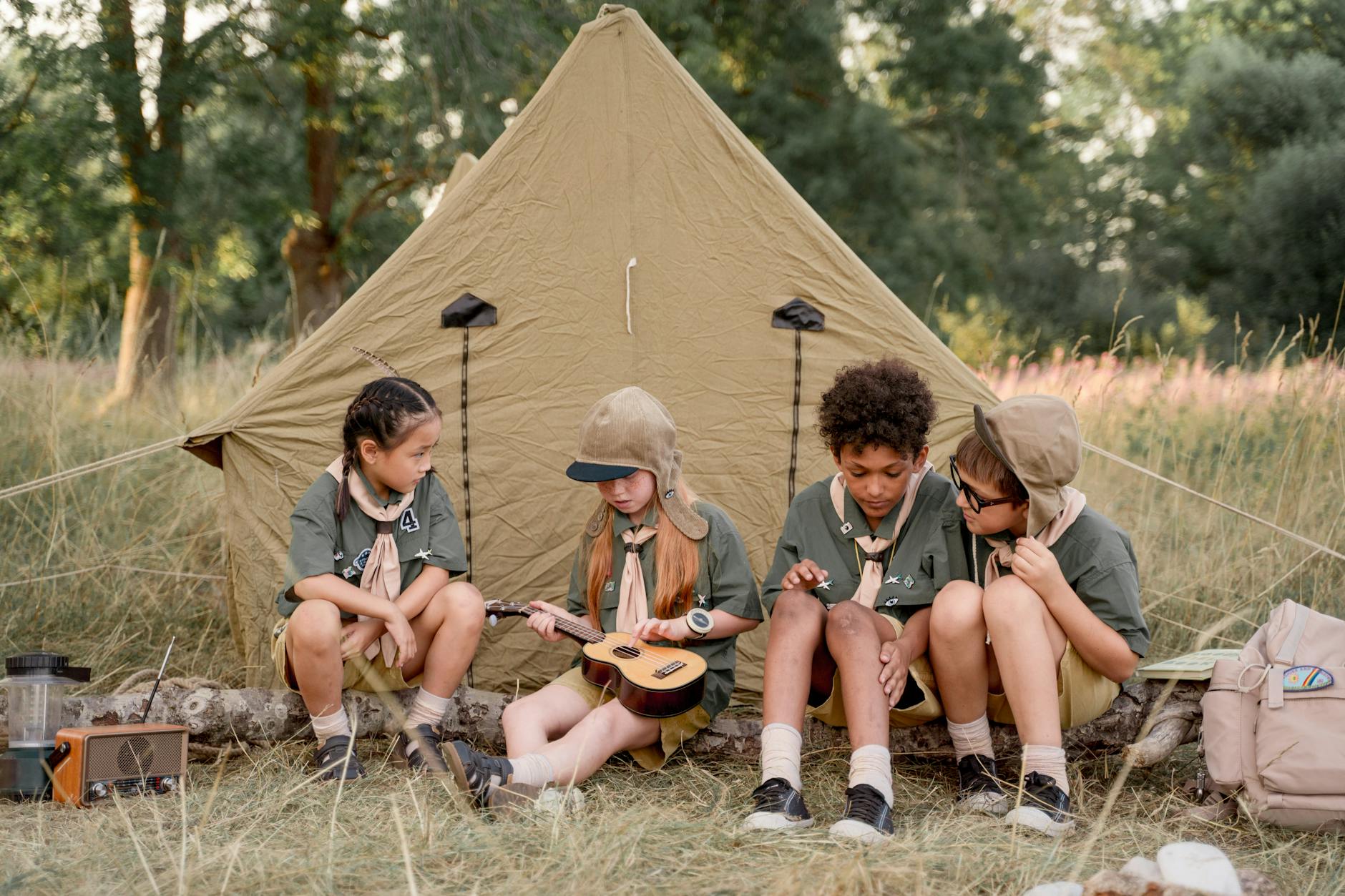
At a campsite, children ages 3-12 have wide open space, natural terrain, and zero screen options. That combination produces a specific kind of energy: restless, exploratory, and hungry for something to chase or throw. Gear that requires sitting, focus, or a flat table does not meet that energy.
Unstructured play — child-directed free play with no rules, goals, or adult instruction — is what camping calls for naturally. Research published in Pediatrics (2018) found that unstructured outdoor play improves executive function and emotional regulation in children ages 3-12 more effectively than structured activities. The campsite is the perfect environment for it. The gear just needs to get out of the way and let it happen.
What Types of Outdoor Toys Travel Best to Campsites?
The outdoor toys that travel best to campsites are soft-foam items under one pound that fit flat in a backpack: foam flying discs, foam boomerangs, catch sets, and lightweight gliders.
The criteria that predict whether a toy will actually get used:
- Lightweight and packable — under 1 lb, no dedicated case required
- Soft or foam construction — safe near tent stakes, fire rings, and other campers
- Self-explanatory — a 4-year-old can pick it up and start playing in under 30 seconds
- Weather-tolerant — survives being left in the rain, dropped in a stream, or stepped on repeatedly
- No flat surface required — works on grass, gravel, and uneven terrain
Hard-plastic toys underperform because they hurt on bad catches. Competitive games requiring tables or net setups underperform because campsites rarely have them. Toys that need charging underperform because there is nowhere to plug them in.
Having the right outdoor gear can make the difference between kids who ask to go outside and kids who resist it. Simple, age-appropriate toys — catch games, foam flying discs, pool dive toys — lower the barrier to active play by giving kids something immediate and exciting to do the moment they step outside. Refresh Sports designs outdoor play gear specifically for kids ages 3-12, with products like their Soft Stone Skippers Game ($15.97), Fun Flying Disc – Soft Frisbee ($13.97), and Toss and Catch Ball Game Set ($27.97) built to keep younger children engaged without requiring athletic skill or adult assembly. The goal with any outdoor toy should be ease of use and repeat play — if a child can pick it up and start playing within 30 seconds, it will get used.
How Do You Pick Camping Gear That Works for Mixed Ages?
Pick camping toys that scale with distance rather than difficulty — catch sets, foam discs, and boomerangs all work for a 3-year-old throwing from 5 feet and a 10-year-old throwing from 30 feet, with no rule changes between them.
Sibling play is the hardest dynamic to solve at a campsite. A toy that works for your 8-year-old bores your 4-year-old within five minutes. The solution is gear where skill level adjusts the distance, not the game:
- Catch sets with velcro paddles — younger kids stand close, older kids back up
- Foam flying discs — toss distance scales with arm strength naturally
- Foam boomerangs — soft enough for small hands, satisfying enough for older kids who want to master the return
The Toss and Catch Ball Game Set ($27.97) from Refresh Sports uses a velcro paddle design specifically so younger children actually catch the ball rather than chasing it into the woods every throw. That catch rate is what holds a 4-year-old’s attention for 30 minutes instead of 4.
How Much Active Play Do Kids Need — Even While Camping?
The 2018 AAP Physical Activity Guidelines recommend 60 minutes of moderate-to-vigorous physical activity daily for children ages 6-17, and at least 3 hours of movement spread throughout the day for children ages 3-5.
Camping removes the main barriers to hitting those targets — screens, scheduled commitments, confined spaces. But kids still benefit from toys that give purposeful structure to their outdoor energy. Without something to throw or chase, the energy often turns into sibling conflict or restlessness by mid-afternoon.
The gross motor skills children develop through throwing, catching, and running — the large-body movements that build coordination, balance, and spatial awareness — are best practiced in exactly the kind of varied outdoor terrain a campsite provides. Uneven ground, mild elevation changes, and natural obstacles turn a simple catch game into a genuine physical challenge.
Screen-free camping environments amplify the effect of active play gear. Research from the Journal of Pediatrics (2019) found that children who spent time in screen-free outdoor environments showed measurably better sleep quality and lower baseline screen demand in the days following the trip. The outdoor stimulation meets sensory and developmental needs that indoor play cannot.
What Happens When Families Get the Outdoor Gear Right?
The investment that pays off most at a campsite is also the smallest. A foam disc, a catch set, a lightweight boomerang — these are the items that get pulled out at 7am and put away at dusk. You do not need elaborate camp kitchens, premium tent setups, or organized activities. You need a few outdoor toys that invite your kids to move, compete mildly, and stay outside for hours without asking to go home.
The Airplane Toy Glider – EVA Foam ($9.39) from Refresh Sports is particularly effective at campsites: light enough to carry in a shorts pocket, flies far enough to make kids sprint across a meadow, and foam-soft enough to throw in wooded clearings without worry. That combination — low pack weight, high play energy — is exactly what family play in an outdoor camping context looks like at its best.
References
- American Academy of Pediatrics. (2018). Physical Activity Guidelines for Children and Adolescents. healthychildren.org.
- Centers for Disease Control and Prevention. (2023). How Much Physical Activity Do Children Need? cdc.gov/physicalactivity.
- Yogman, M., et al. (2018). The power of play: A pediatric role in enhancing development in young children. Pediatrics, 142(3).
- Becker, D.R., et al. (2019). Associations between screen time, outdoor play, and children’s sleep quality. Journal of Pediatrics, 208, 166–172.
- For educational guides on outdoor play and child development, visit raisingactivekids.com. Buying guides for family outdoor games and backyard games by age: backyardplayguide.com.
- American Academy of Pediatrics — healthy active living for families
- CDC physical activity guidelines for children and adolescents